
Designing a Transparent AI Assistant for Healthcare Portals
An AI-powered lab result translator that improves patient comprehension, builds calibrated trust through transparency, and supports real-world decision-making without replacing clinicians.
Project Overview
Clearpath Healthcare is an AI-enabled health portal concept designed to improve how patients understand lab results.
The project explores how LLM-powered systems can translate complex medical terminology into plain language while calibrating trust through transparency, confidence cues, and safe escalation pathways.
Project Housekeeping
UX Designer and UX Researcher - AI Experience Design
Course - Data Driven Interaction Fundamentals (Fall 2025)
Duration - 16 weeks | Team of 6
Problem and Challenge
We wanted to design an AI assistant that improves comprehension without encouraging over-reliance in high stakes healthcare environment
The challenge was not simply adding conversational AI, but designing trust calibration, transparency, and clear human escalation into the experience.
Process
-
Over a 16-week period, we followed an iterative, mixed-methods research process that moved from exploration to validation. The goal was to understand how users interpret medical communication and to evaluate how an AI-assisted interaction could improve clarity and trust in healthcare correspondence.
To evaluate the proposed AI interaction before implementation, we used a Wizard-of-Oz method, simulating AI responses during usability sessions. This approach enabled us to test the interaction model without requiring a fully implemented AI system, allowing us to evaluate clarity, discoverability, trust perception, and escalation behavior.
The study involved eight unique participants across exploratory interviews and iterative usability testing phases. -
We conducted six exploratory interviews with users to understand how they currently interpret medical correspondence and healthcare communication. These interviews helped identify key pain points, user mental models, and common challenges in understanding medical information.
-
A confirmatory survey was conducted to validate insights from the exploratory interviews and to identify and prioritize potential use cases for Clearpath Healthcare.
-
Using validated storyboards, OV-1 diagrams, and GAUSTR analysis, we developed a low-fidelity prototype representing the proposed AI-assisted interaction flow.
-
Six formative usability interviews were conducted to evaluate the prototype and identify strengths, usability issues, and areas for improvement. Insights from these sessions informed iterative design refinements.
-
After multiple design iterations incorporating feedback from formative testing, we conducted six summative validation interviews to assess the effectiveness, clarity, and usability of the refined prototype.
Solution
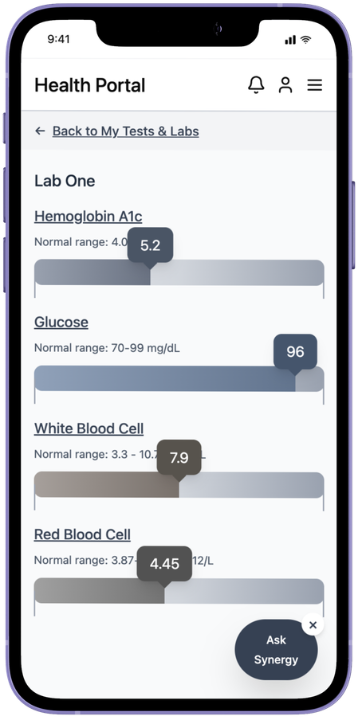
We designed “Synergy,” an AI assistant embedded directly within the patient portal.
In-Context Explanations
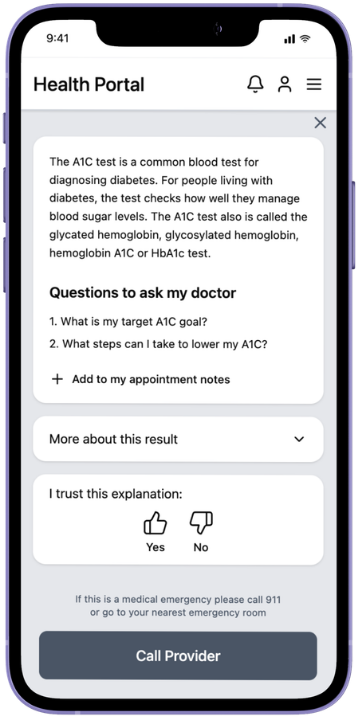
Plain-language interpretation displayed next to lab values.Tap-to-Explain Medical Terms
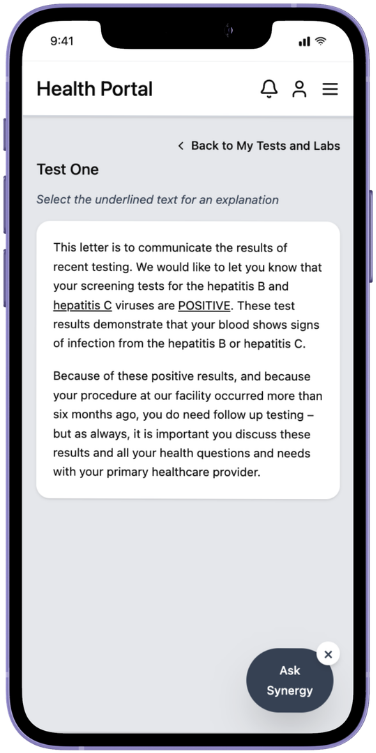
Users can select terminology within result letters for contextual support.Questions to Ask My Doctor
AI-generated prompts that can be added directly to appointment notes.Integrated Workflow
The assistant supports patient-provider conversations rather than replacing them.
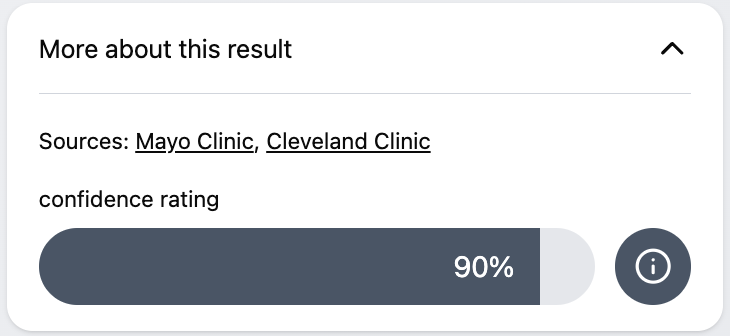
Designing for Responsible AI
Because healthcare is high-stakes, transparency and safety were foundational to the interface.
Transparency
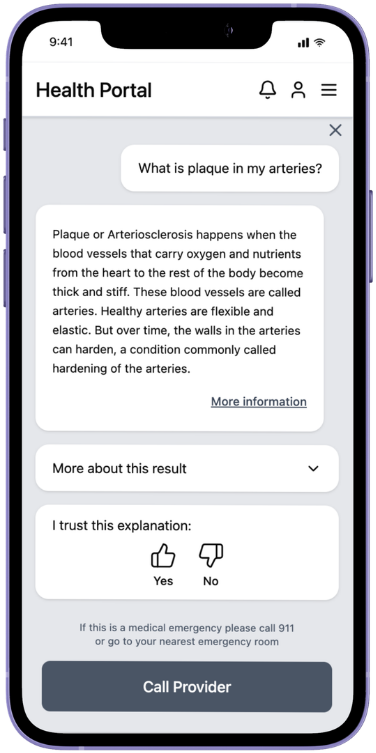
Verified medical sources are displayed directly within the interface.
Trust Calibration
A visible confidence indicator and user trust feedback loop help prevent overreliance.
Safe Escalation
Clear “Call Provider” pathways and emergency disclaimers reinforce human oversight.